

Air-Gapped AI for Defense Contractors: When the Perimeter Is the Whole Point
A Different Compliance Frame Most regulated industries care about commercial compliance: GDPR, HIPAA, SOC 2, PCI, DORA. …

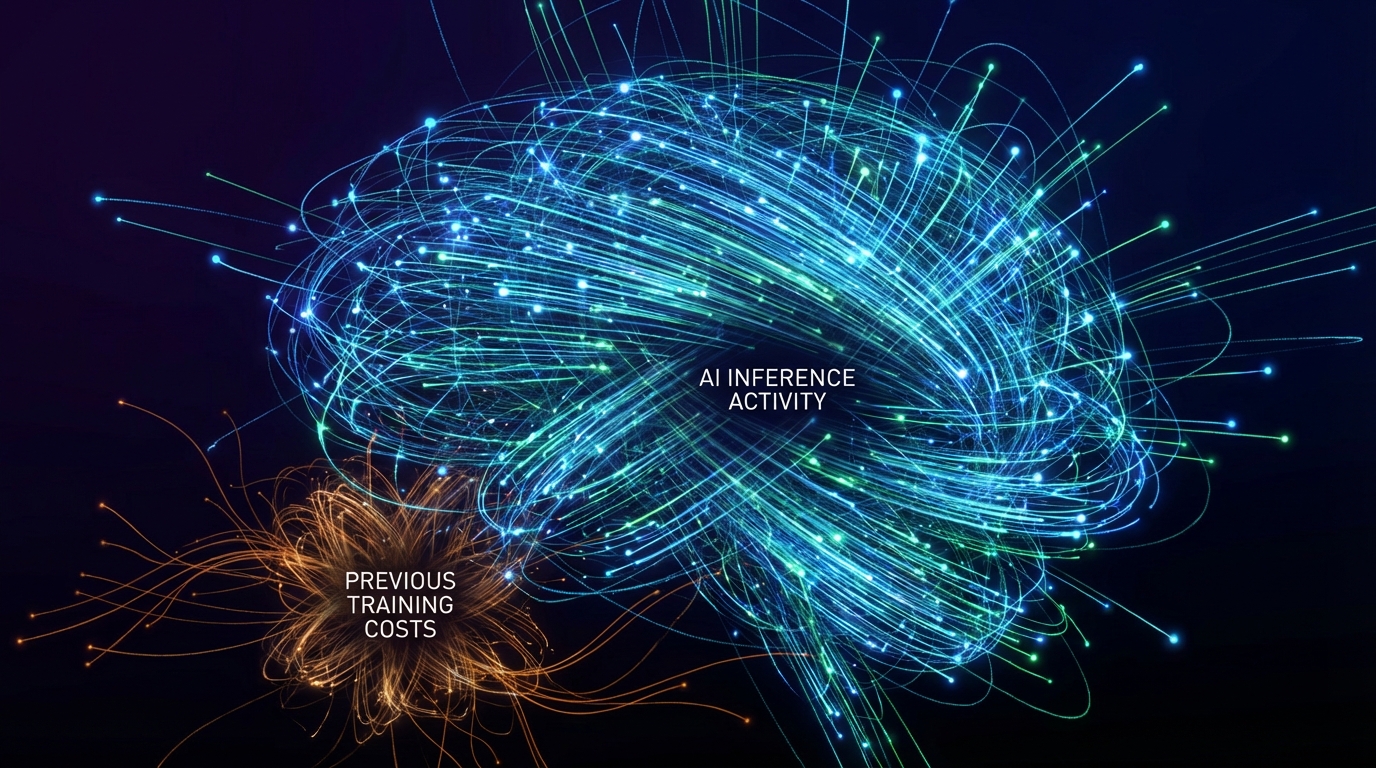

For years, the expensive part of AI was training. Build the model, spend millions on GPU clusters, wait weeks, hope the loss curves cooperate. Inference — actually running the model in production — was an afterthought. A rounding error on the balance sheet.
That era is over.
As of early 2026, inference accounts for 55% of AI cloud spending. That’s roughly $37.5 billion going to the act of running models, not building them. Inference workloads now consume about two-thirds of all AI compute, up from one-third in 2023. The inference-optimized chip market alone has crossed $50 billion.
This is a structural inversion, and most organizations haven’t caught up to what it means for how they plan, budget, and architect their AI infrastructure.
The training cost story is well understood. A frontier model costs hundreds of millions to train. The number goes up every generation. This is the story the press writes.
But training happens once. Maybe a few times a year. Inference happens every second of every day, for every user, across every deployment. And three things have conspired to make inference costs explode.
The first generation of AI products was simple: user sends prompt, model returns response. One call. In 2026, that pattern is the exception.
Agentic workflows — where an AI system reasons, plans, uses tools, checks its work, and iterates — routinely make 10 to 20 LLM calls per task. A coding agent that reads a codebase, plans a change, writes code, runs tests, reads error messages, fixes bugs, and verifies the result might hit a model 15 times before it produces a single pull request.
Multiply that by every developer on your team, every task, every day. The per-task compute cost of agentic AI is an order of magnitude higher than chat-style AI.
Retrieval-augmented generation was supposed to keep things efficient: retrieve relevant context, stuff it into the prompt, get a grounded answer. In practice, context windows have ballooned to hundreds of thousands of tokens, and organizations are stuffing increasingly large chunks of retrieved data into every call.
The logic makes sense — more context means better answers. The economics don’t. Every additional token in the context window costs compute. When your RAG pipeline retrieves 50,000 tokens of context for a query that could have been answered with 5,000, you’re paying a 10x premium on every call. At scale, this is a line item that shows up in quarterly reviews.
The third driver is the most insidious: AI systems that never turn off. Monitoring agents. Compliance watchers. Customer support bots. Code review agents running on every commit. Security scanning agents watching every deployment.
These aren’t burst workloads. They’re steady-state compute consumers running 24/7/365. And unlike a training run that finishes, inference demand scales linearly with the number of systems you deploy and the traffic they serve.
Here’s where it gets uncomfortable for organizations that went all-in on cloud-hosted AI.
The standard cloud value proposition is that you trade capital expense for operational expense. You don’t buy hardware — you rent it. This makes sense when workloads are spiky, unpredictable, or temporary. Training runs fit this pattern well.
Inference workloads often don’t.
When you’re running models continuously at high utilization — which is what always-on agents and high-traffic inference endpoints look like — the cloud pricing model works against you. You’re paying a premium for elasticity you don’t need.
The breakeven math is straightforward: when cloud costs exceed 60-70% of equivalent on-premises acquisition costs on an annualized basis, owning the hardware becomes cheaper. A lot of organizations running production inference at scale have crossed that threshold without realizing it, because the costs accumulated gradually across multiple teams and services.
This isn’t theoretical. Deloitte’s 2026 AI infrastructure analysis describes a growing shift toward private infrastructure for inference workloads, driven by exactly this economic reality.
What’s emerging isn’t a wholesale retreat from the cloud. It’s a more nuanced architecture that puts workloads where the economics make sense.
Tier 1: Public cloud for training and experimentation. Training runs are spiky and temporary. Experimentation is unpredictable. This is where cloud elasticity genuinely earns its premium. Spin up a cluster, train a model, tear it down. Pay for what you use.
Tier 2: Private infrastructure for high-volume inference. When you know the workload, know the demand pattern, and need to run it continuously, owned or leased hardware on-premises (or in a colo) delivers dramatically better unit economics. This is where the bulk of inference spend should land for organizations at scale.
Tier 3: Edge for latency-critical decisions. Some inference can’t tolerate a round trip to a datacenter. Real-time fraud detection, autonomous system control, point-of-sale recommendations — these push smaller, optimized models to the edge. The compute is cheap; the latency savings are the point.
This isn’t revolutionary architecture. It’s the same hybrid pattern that enterprise IT settled on for general compute a decade ago. AI is just catching up to the same economic realities.
One of the most underappreciated cost levers in inference is semantic caching.
The concept is simple: many queries to an AI system are similar or identical to previous queries. If you can identify when a new query is semantically close enough to a previously answered one, you serve the cached response instead of running inference again. The cost of serving a cached response is near zero compared to a full model call.
In practice, semantic caching works by embedding queries and comparing them against a vector store of previous query-response pairs. When similarity exceeds a threshold, the cached response is returned. For customer support, internal knowledge bases, and documentation-style queries, cache hit rates above 40% are common.
At 40% cache hit rate, you’ve cut your inference compute by 40%. No model changes. No architecture overhaul. Just not re-answering questions you’ve already answered.
The organizations that are winning on inference economics in 2026 aren’t necessarily running the most efficient models. They’re running the smartest caching layers in front of whatever models they use.
Here’s a number that sounds encouraging: the cost of GPT-4-equivalent inference has dropped from roughly $400 per million tokens to about $0.40 per million tokens in three years. A thousand-fold reduction.
This is real, and it matters. But it obscures a critical detail: a significant portion of this price collapse is subsidized by venture capital, not driven by genuine cost reduction.
API providers are pricing inference below cost to acquire market share and lock in developer ecosystems. When the subsidy ends — and it will, because it always does — the pricing resets. By then, your architecture is built around a specific provider’s API, your team’s workflows depend on it, and migration costs are substantial.
Building your production inference strategy around VC-subsidized pricing is like signing a lease because the first three months are free. The monthly rate is what matters.
The organizations that will manage AI economics effectively over the next few years share a few characteristics:
They treat inference as a first-class infrastructure concern, not a line item hidden inside API bills. They measure it, plan for it, and architect around it.
They own their high-volume inference infrastructure. Not because on-prem is fashionable, but because the math says it’s cheaper when you’re running models at scale, continuously.
They implement intelligent caching and request deduplication before they optimize the models themselves.
They keep their options open. Open-weight models running on infrastructure you control means you can switch models, update them, fine-tune them, and optimize them without asking permission or paying a switching cost.
And they don’t build production systems on subsidized pricing.
The inference cost crisis isn’t a temporary market condition. It’s the new shape of AI economics. Training is a one-time event. Inference is the operating cost of every AI system you deploy, forever. The sooner your infrastructure strategy reflects that reality, the better your position when the bills come due.
Calliope gives teams the infrastructure to run AI models on their own hardware — training, inference, and everything in between. Your compute. Your control.
A Different Compliance Frame Most regulated industries care about commercial compliance: GDPR, HIPAA, SOC 2, PCI, DORA. …

The Category Most AI Vendors Pretend Doesn’t Exist A surprising amount of the world’s most consequential …