

Air-Gapped AI for Defense Contractors: When the Perimeter Is the Whole Point
A Different Compliance Frame Most regulated industries care about commercial compliance: GDPR, HIPAA, SOC 2, PCI, DORA. …

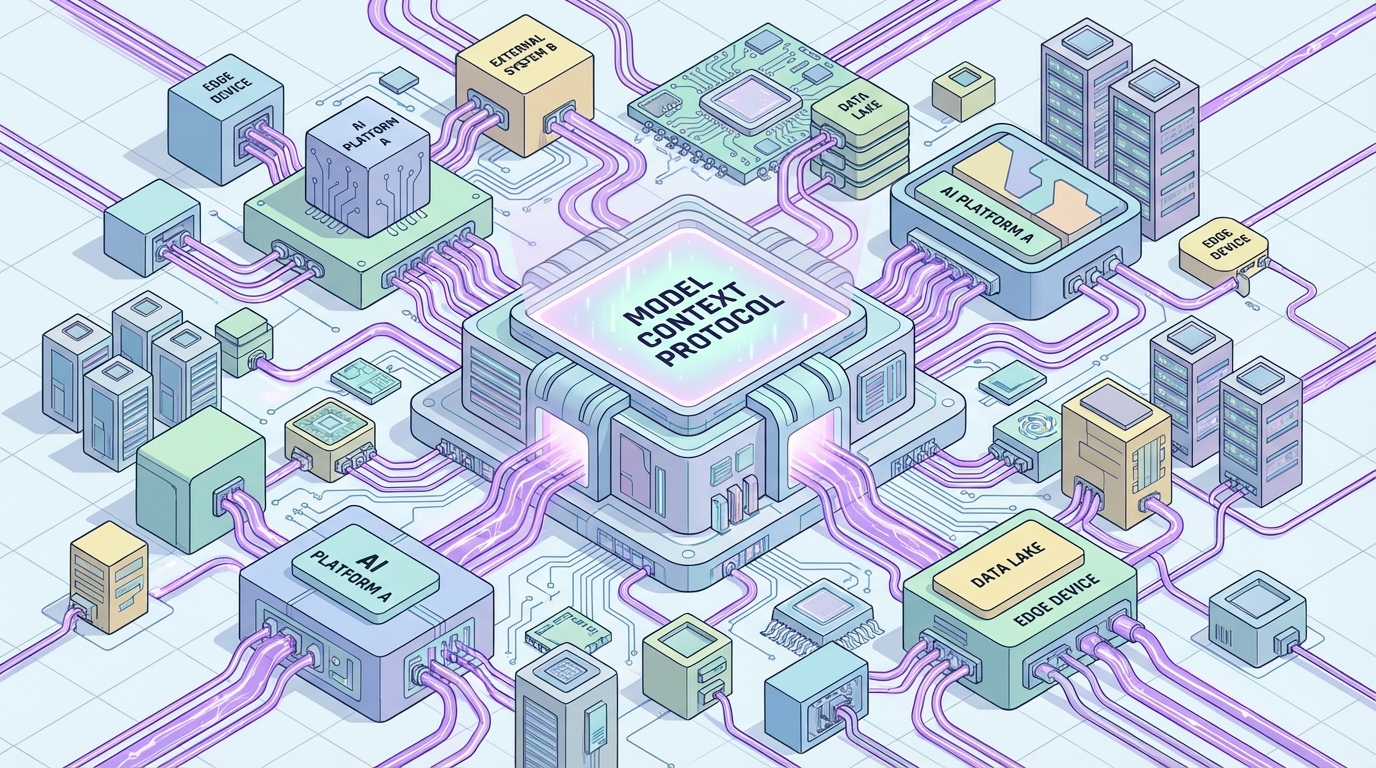

For the past two years, every AI platform, every agent framework, and every tool vendor was building their own way for models to talk to the outside world. Custom APIs. Proprietary plugin systems. Bespoke function-calling schemas. If you wanted your AI agent to query a database, read a file, or call an API, you were writing glue code. Lots of it.
That era is done.
The Model Context Protocol — MCP — has won. Not in the way standards usually win, through slow committee attrition and grudging adoption. MCP won fast, decisively, and with a breadth of industry support that’s rare for any protocol, let alone one that didn’t exist before late 2024.
The numbers tell the story: 97 million monthly SDK downloads across Python and TypeScript. Adopted by Anthropic, OpenAI, Google, Microsoft, and Amazon. Donated to the Linux Foundation’s Agentic AI Foundation in December 2025, with OpenAI and Block as co-founders and AWS, Google, Microsoft, Cloudflare, and Bloomberg as supporting members. Every major AI provider is building on MCP. The integration ecosystem is exploding.
The question is no longer “which protocol will win?” It’s “what does winning look like for your team?”
If you haven’t been tracking this closely, here’s the short version.
MCP is an open standard that defines how AI models interact with tools and data sources. Think of it as a universal adapter between any AI model and any external capability — databases, APIs, file systems, code interpreters, search engines, enterprise applications. Instead of every model vendor building proprietary integrations with every tool vendor (an N-times-M problem), MCP gives you a common interface. Build an MCP server once, and every MCP-compatible model can use it.
The architecture is straightforward: MCP clients (your AI application) connect to MCP servers (wrappers around your tools and data). The protocol handles capability discovery, tool invocation, context passing, and result streaming. The model doesn’t need to know the implementation details of your Postgres database or your Salesforce instance. It just speaks MCP.
This is conceptually similar to what USB did for hardware peripherals or what LSP (Language Server Protocol) did for code editors. One protocol, universal compatibility. The analogy to LSP is especially apt — both were created by a single company (Microsoft for LSP, Anthropic for MCP), both solved a combinatorial integration problem, and both became industry standards because the alternative was too painful.
Three reasons, in order of importance.
First: the pain was real. Before MCP, integrating an AI agent with enterprise tools meant months of custom development per integration. You’d wire up one model to one database using one vendor’s function-calling format, and then you’d do it all over again when you switched models, added a new data source, or adopted a different agent framework. Development teams were spending 60-70% of their integration budgets on glue code that added zero business value. MCP drops time-to-integration from months to weeks and cuts integration costs by up to 70%.
Second: Anthropic gave it away at the right time. Releasing MCP as an open specification in November 2024, then donating it to the Linux Foundation a year later, was a masterclass in standards strategy. By the time competitors could have built alternatives, MCP already had critical mass. OpenAI’s decision to adopt MCP rather than push their own standard was the decisive moment — it signaled that even the most dominant player in the space saw more value in a shared standard than a proprietary one.
Third: the March 2025 update made it enterprise-viable. The original MCP transport layer used Server-Sent Events (SSE), which was fine for local development but a nightmare for enterprise deployments. SSE requires persistent connections, doesn’t play well with corporate firewalls and WAFs, and makes load balancing awkward. The March 2025 revision replaced SSE with Streamable HTTP — a single /mcp endpoint that works with standard HTTP infrastructure, supports session resumability via the Mcp-Session-Id header, and fits cleanly into enterprise network architectures. That one change removed the biggest technical objection to enterprise adoption.
Beyond the transport overhaul, MCP has matured in ways that matter for production deployments.
Tool Annotations are the most consequential addition. MCP servers can now tag tools with metadata like readOnly and destructive, which tells the client whether a tool just reads data or can modify state. This is the foundation for human-in-the-loop workflows — your agent can autonomously execute read-only operations but pause for approval before running anything destructive. For anyone building agents that interact with production systems, this is table stakes.
Audio Content Support extends MCP beyond text. Servers can now return audio content blocks, enabling voice and text-to-speech integrations. This matters less for developer tooling and more for customer-facing AI applications, but it signals that MCP is positioning itself as the universal model-to-world interface, not just a developer tool protocol.
The ecosystem exploded. MCP server implementations now exist for virtually every major enterprise platform — databases (Postgres, MySQL, MongoDB, Snowflake), SaaS tools (Salesforce, Jira, Slack, GitHub), cloud services (AWS, GCP, Azure), and domain-specific applications across finance, healthcare, and legal. The community has built thousands of servers, and enterprise vendors like CData are packaging pre-built MCP connectors that turn any of their 400+ supported data sources into MCP-compatible endpoints.
Here’s where the honest assessment comes in. MCP has won the protocol war, but it hasn’t won enterprise trust. Not yet.
The current specification has real gaps for organizations that care about security, compliance, and governance — which is to say, every organization that matters.
Authentication and authorization are still underspecified. MCP doesn’t define a standard auth model. In practice, this means every MCP server implements auth differently, and integrating MCP into your existing SSO and RBAC infrastructure requires custom work. The 2026 roadmap acknowledges this explicitly — SSO-integrated auth is a priority, but it’s not shipped yet.
Audit trails are a gap. When an AI agent calls an MCP tool to query your customer database or modify a production configuration, there’s no standardized way to log what happened, who authorized it, and what the result was. For regulated industries, this is a blocker.
Gateway behavior isn’t standardized. Enterprises want to run MCP through centralized gateways that enforce policies, rate limits, and access controls. The protocol doesn’t define how gateways should behave, which means every vendor’s MCP gateway works differently.
Configuration portability is missing. If you define a set of MCP server configurations for your organization, there’s no standard way to package and distribute that configuration across teams, environments, or CI/CD pipelines.
The 2026 MCP roadmap is focused squarely on these problems: transport scalability, agent-to-agent communication, governance maturation, and enterprise readiness. The protocol authors know where the gaps are. The question is whether the ecosystem fills them before enterprise buyers lose patience.
This is the part that connects directly to how you deploy.
MCP servers are, by design, wrappers around your most sensitive capabilities. Your databases. Your internal APIs. Your production systems. When an AI agent talks to an MCP server, it’s accessing your data through a standardized interface — which is powerful, and also exactly the kind of thing that should never transit infrastructure you don’t control.
Running MCP servers inside your own network perimeter isn’t just a security preference. It’s the architecturally correct choice for enterprise deployments, especially while the protocol’s auth and audit capabilities are still maturing.
When MCP servers run inside your perimeter:
This is how we think about it at Calliope . The protocol is the standard, but the deployment model determines whether it’s secure. MCP inside your perimeter, connected to your models running on your infrastructure, gives you the full power of standardized tool integration without the data exposure.
MCP adoption isn’t optional at this point. If you’re building AI agents or integrating AI into your workflows, you’re going to end up on MCP whether you plan for it or not. The ecosystem has tipped.
Here’s the practical playbook:
Start with read-only MCP servers. Connect your AI tools to data sources through MCP, but start with read-only access. Use Tool Annotations to enforce it. Get comfortable with the protocol before giving agents write access to anything.
Run MCP servers inside your network. Don’t use hosted MCP endpoints for sensitive data sources. Deploy MCP servers as internal services, behind your firewall, subject to your security policies.
Build your own audit layer. Don’t wait for the spec. Log every MCP request and response. Capture who initiated it, what tool was called, what parameters were passed, and what was returned. You’ll need this for compliance, and you’ll want it for debugging.
Watch the auth story. The 2026 roadmap promises SSO-integrated authentication. Until it ships, implement auth at the infrastructure level — mTLS, API keys, OAuth proxies, whatever fits your existing stack.
Plan for agent-to-agent communication. The next wave of MCP development is multi-agent architectures where agents discover and communicate with each other through the protocol. This is coming fast, and the teams that understand MCP’s agent communication patterns will have a head start.
MCP becoming the universal standard for AI-tool integration is unambiguously good. It eliminates the integration tax that was slowing down every AI deployment. It creates a portable ecosystem where tools built once work everywhere. It gives enterprises a common language for managing how AI interacts with their systems.
But a protocol is just a protocol. It defines the interface, not the deployment. The same MCP specification that lets you connect AI agents to your tools through a cloud provider’s managed service also lets you run the entire stack on your own infrastructure, inside your own network, under your own control.
The protocol wars are over. The architecture decisions are just beginning.
A Different Compliance Frame Most regulated industries care about commercial compliance: GDPR, HIPAA, SOC 2, PCI, DORA. …

The Category Most AI Vendors Pretend Doesn’t Exist A surprising amount of the world’s most consequential …